Office design is continuing to evolve as organisations adapt to new ways of working, rapid advances in technology, and rising employee expectations. In recent years, hybrid working, flexible layouts, and biophilic design have reshaped how people use and experience the workplace.
As we move into 2026, this evolution is accelerating, with businesses placing greater emphasis on sustainability, human-centric design, and data-driven decision-making.
For companies focused on attracting talent, supporting wellbeing, and creating workplaces that can adapt to the future, staying ahead of these shifts is essential. Below, we explore the key office design trends set to define the workplace in 2026 and beyond.
1. Sustainability and circular design
Sustainability remains a major priority in 2026, with more businesses seeking workplaces that are both environmentally responsible and cost-effective. Many organisations are moving away from full-scale rebuilds and adopting a retrofit-first approach, upgrading what they already have rather than starting from scratch. New guidance even requires retrofit projects to retain and reuse at least 50% of the existing building’s superstructure by mass, reinforcing the move toward preservation over demolition. This shift not only reduces waste but also lowers carbon impact and keeps projects more affordable.
With more than 40% of senior executives now considering ESG performance when choosing an employer, sustainability is also becoming a long-term driver of talent attraction. To meet these expectations, companies are increasingly choosing recycled and renewable materials, reusing furniture through refurbishment schemes, and selecting low-carbon finishes that align with their sustainability goals.
As we move through 2026, energy-efficient lighting, smart climate control, and modular construction systems will also continue to influence modern office design, helping organisations shrink their environmental footprint while staying adaptable for the future.
2. AI in the workplace
AI is continuing to reshape the workplace, helping offices run more smoothly and giving employees smarter tools to do their jobs. In 2026, more organisations are turning to AI-powered booking systems, predictive space planning, and intelligent environmental controls that automatically adjust lighting, temperature, and energy use. These technologies make workplaces more efficient, more sustainable, and more supportive of the people using them.
AI is also becoming a bigger part of everyday work. A September 2025 Pew Research Center survey found that 21% of workers now complete at least some of their tasks with the help of AI. As this number grows, businesses need to think carefully about how AI affects work quality and accuracy. Clear policies, training, and practical guardrails can help employees use AI responsibly and avoid becoming overly dependent on automated tools.
Looking ahead, AI will play an even larger role in creating personalised and adaptive workplaces. From tools that help employees find the right space for their tasks to systems that learn how teams collaborate, AI will continue to support smarter and more responsive working environments. Organisations that balance innovation with thoughtful governance will benefit the most from what AI can offer.
3. Wellbeing and ergonomics
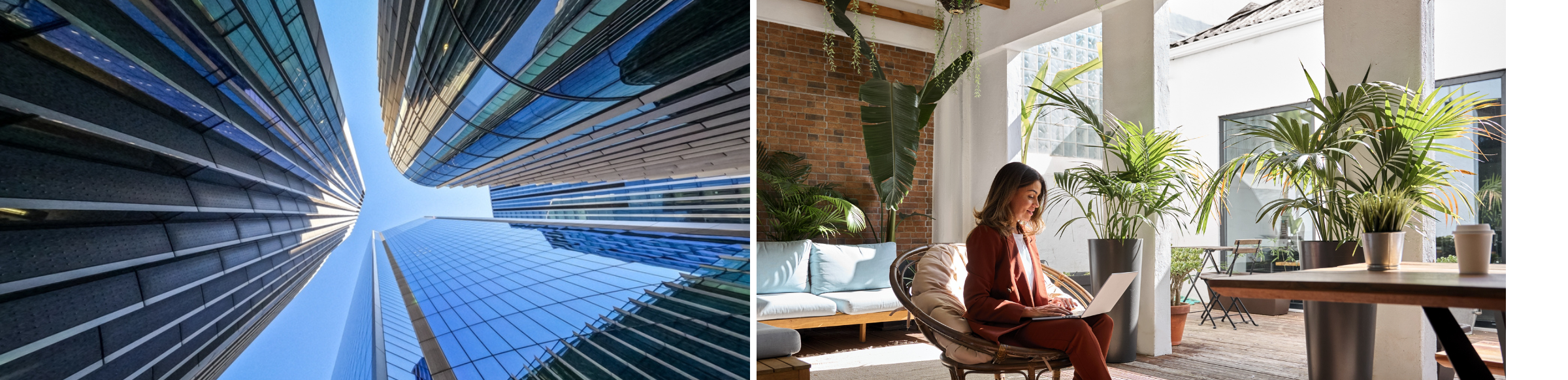
Employee wellbeing remains central to workplace design, with offices increasingly shaped to support both physical comfort and mental health. Natural light, biophilic elements, and calming materials help create restorative environments, while dedicated wellness areas and quiet rooms give employees space to pause and reset.
Ergonomics continue to evolve, with adjustable furniture, sit-stand desks, and active workstations encouraging healthier movement throughout the day. Many organisations are also adopting sensory-aware and neuroinclusive design, providing a balance of social, collaborative zones and quieter focus areas to suit different working styles.
Air quality, acoustic comfort, and access to outdoor space are now recognised as essential to wellbeing. Smart monitoring systems and thoughtfully designed breakout areas further contribute to healthier, more supportive workplaces.
By prioritising comfort, choice, and psychological safety, businesses are creating environments where people feel engaged, supported, and able to perform at their best.
4. Adaptive workspaces
As hybrid working continues to mature, offices in 2026 are evolving from static layouts into adaptive, multi-purpose environments designed to meet changing business and employee needs. With many people choosing to work from home for focused tasks, the office must offer something different: spaces that minimise distraction, support collaboration, and give employees a clear reason to be there.
To achieve this, organisations are adopting architectural zoning, advanced acoustic solutions, and tech-enabled meeting rooms that support a range of work modes, from deep focus to creative teamwork. Increasingly, decisions about space allocation are informed by utilisation data, helping businesses understand how rooms, desks, and collaboration areas are actually being used.
Flexibility is no longer just about movable furniture; it has become a strategic capability. Companies are integrating modular furniture systems, demountable partitions, and reconfigurable workstations that allow spaces to shift quickly without major disruption. Workspaces that can adapt in this way help organisations minimise costly redesigns and make far better use of the space they have.
5. Human-centric design
Workplaces are shifting toward human-centred design, creating environments that genuinely support the people who use them. While offices will continue to draw inspiration from hotels and luxury spaces, the real focus is on how people think, feel, collaborate, and connect.
Human-centric workplaces use intentional design to nurture these needs. Social spaces and collaboration hubs bring people together naturally, strengthening relationships and fostering community. Quiet zones, restorative areas, and sensory-aware design give individuals the control, comfort, and privacy they need to focus or recharge.
Creating a truly human-centric workplace goes beyond aesthetics or amenities. It starts with listening. More organisations are now using employee surveys, behavioural insights, and pulse feedback to understand how teams actually work: what supports their productivity, what creates friction, and what would make the office a place they genuinely want to be. These insights guide decisions on everything from spatial zoning to furniture selection, ensuring the workplace reflects real human experience rather than assumptions.
Looking to future-proof your workplace? Whether you’re redesigning your office or searching for a new space, our Office Design Process Guide will walk you through every step.
