When organisations approach workplace design, lighting is often considered late in the process, treated as a functional requirement rather than a priority. However, its impact is felt continuously, shaping how people focus, collaborate and feel within a space. Whether supporting early-morning focus or helping overcome mid-afternoon fatigue, lighting plays a crucial role in workplace performance. When approached the right way, it can act as a subtle but effective driver of productivity, reinforcing both culture and employee engagement.
Why office lighting matters
Lighting influences far more than visibility. It shapes concentration, contributes to comfort and plays a key role in how people experience their working environments each day. Increasingly, it is being recognised as a driver of employee energy, engagement and productivity. Recent studies also report that three in four office workers experience symptoms of digital eye strain, including headaches, blurred vision and fatigue, often linked to prolonged screen use and poor lighting conditions.
Effective lighting, by contrast, creates a balanced environment that supports different tasks, complements natural daylight and responds to the needs of the people using the space. When aligned with the wider workplace design, it helps create conditions where individuals and teams can perform at their best.
Here, we outline five office lighting principles to help shape a more effective, people-focused workplace.
1) Maximise natural light
Maximising daylight should be a priority wherever possible. Positioning workstations near windows, incorporating glass partitions and selecting reflective finishes can help distribute light more evenly across the space. Beyond improving visibility, access to natural light has been linked to a 51% reduction in eye strain, 63% fewer headaches and 56% less drowsiness among employees.
2) Layer artificial lighting effectively
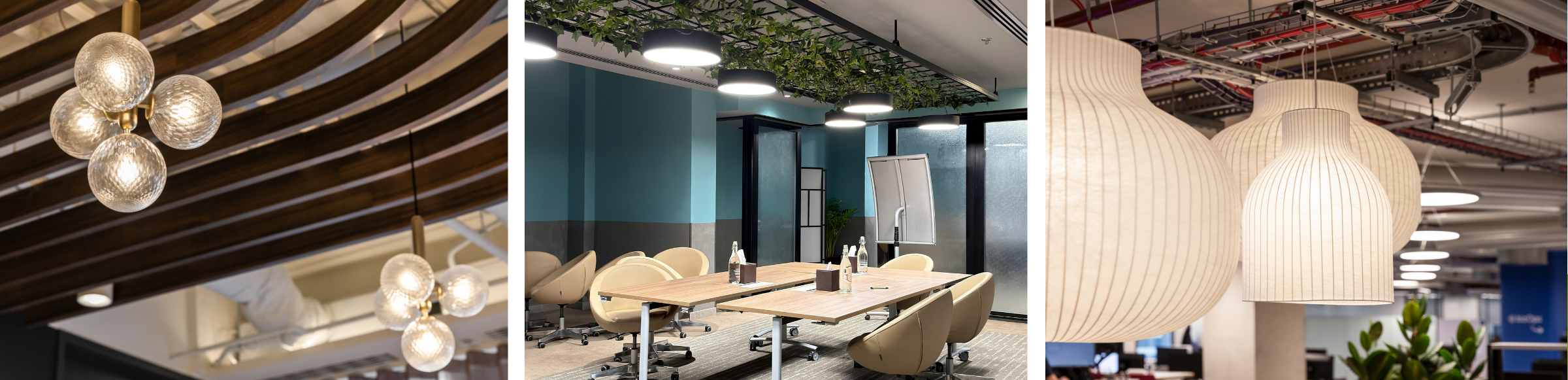
Where access to natural light is limited, artificial lighting plays a critical role in maintaining a comfortable and effective working environment. Ambient lighting provides consistent overall illumination, for example, through ceiling-mounted LED panels that evenly light an open-plan workspace. Task lighting supports more focused activities at desk level, such as adjustable desk lamps used for reading or detailed work. Accent lighting can then be used to define different areas and introduce depth within the space, for instance, through feature pendants in breakout areas or wall lighting along circulation routes. When combined, these elements create a more flexible and functional environment that supports a range of tasks and working styles.
3) Introduce adaptive lighting
Lighting should respond to changing conditions, whether that is time of day, occupancy or seasonal variation. Adjustable systems, such as dimmable lighting or variable colour temperatures, help maintain consistent comfort and performance as these conditions shift. Adaptive lighting is particularly effective in spaces such as meeting rooms, where requirements can vary between presentations, video calls and group discussions. By integrating this flexibility, organisations can create more responsive environments that reduce discomfort and support sustained focus over time.
4) Use smart and energy-efficient systems
Smart, energy-efficient solutions, particularly LED-based systems, allow organisations to balance performance and sustainability without compromising user experience. LEDs, especially those with a high Colour Rendering Index (CRI), can closely replicate natural light while providing consistent illumination and improved visual clarity. Compared to traditional systems, LED lighting offers greater longevity and can reduce energy consumption by up to 75%, delivering significant cost savings over time. When combined with smart controls, such as occupancy sensors and daylight-responsive dimming, lighting can automatically adjust to how a space is used, improving efficiency while maintaining appropriate light levels throughout the day.
5) Align lighting with circadian rhythm
Lighting that reflects the body’s natural rhythms is increasingly being integrated into office environments. Cooler, brighter light in the morning helps stimulate energy and concentration, while warmer tones later in the day support a more gradual transition towards rest. By aligning lighting with these natural cycles, organisations can better support the body’s circadian rhythm, which plays a key role in sleep quality, mood and overall wellbeing. Research suggests this approach can also increase daytime alertness and reduce fatigue, helping to maintain focus and performance over time.
Effective office lighting is not defined by a single solution but by how well it supports the people using the space each day. From maximising natural light to integrating smart systems and aligning with circadian rhythms, each principle plays a role in creating a workplace that balances performance, comfort and wellbeing. When considered as part of a wider workplace strategy, lighting becomes an integral part of how the environment functions on a day-to-day basis, influencing both productivity and employee experience.
For a broader view on how lighting fits into the full workplace journey, explore our guide to the office design process.
